John McKim wrote Fly Tying – Adventures in Fur, Feathers and Fun in 1982. It was one of the first fly tying books I bought while trying to learn how to tie flies. John is an author, former directory of the Federation of Fly Fishers (before the name change) and an artist. In this book he illustrates the flies and tying technique with his own black and white drawings.His drawings explain things better than a photograph would.
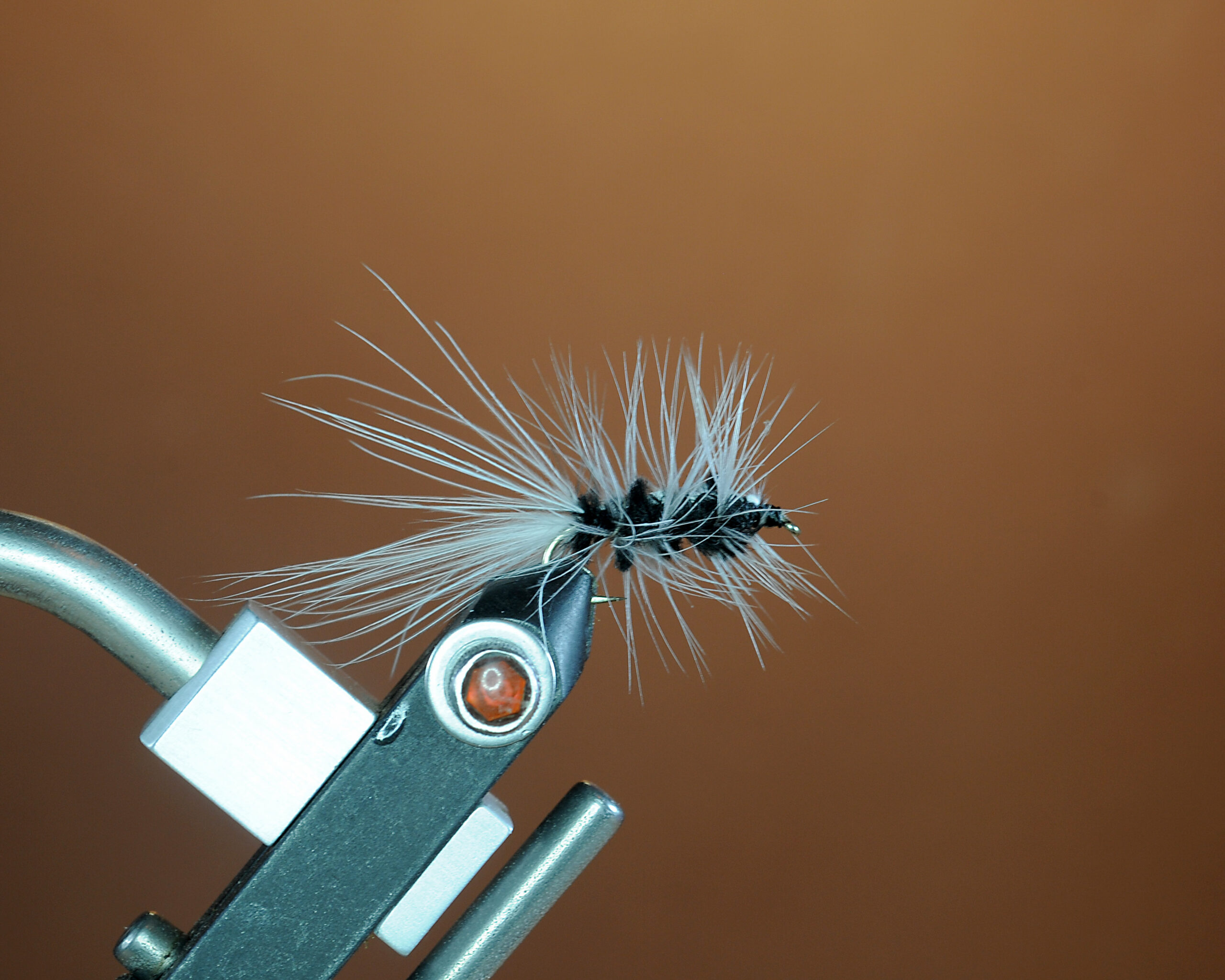
The fourth pattern in the book is the Skunk Woolly Worm. McKim attributes this pattern to Larry Stoner from California. It is however a variation if the Woolly Worm or Woolly Bugger whose origins have been lost in time. The only difference is that the white tail is tied on last and folded back over the body to form the white strip running over the back of the fly. Hence, the name Skunk.
The Skunk is easy to tie. It works well for panfish and Trout.
Materials
Hook: Lightening Strike NW1 size 10. Or your choice of wet fly hook 2xl.
Thread: 3-0 black. 6-0 or 8-0 thread also works.
Hackle: Hen neck hackle wet fly grade. Your choice of color.
Body: Small diameter black chenille over 4-8 wraps lead wire if desired.
Overbody and Tail: White marabou Barbs.
Head: Tying thread.
Tying the Skunk
Place the hook in the vice. Attach the tying thread to the hook with a jam knot and wind to a point opposite the barb of the hook. Be sure to leave plenty of head space. Head space is the distance between the tying thread and the eye of the hook. Head space is designed to allow for a properly proportioned head and long enough to allow you to tie off your materials and complete the fly. Crowding the eye of the hook is a common mistake of beginners.

Select a hackle and strip off the fluff at the base. Tie in he hackle with the shinny side forward. Clip off the excess stem.

Select a 2-3 inch piece of black chenille. Pull some of the short black fuzz from one end of the chenille exposing the two strands of thread that runs through the center. Attach these two threads to the shank of the hook at the same place the hackle was tied in.

Note the two threads.

If you desire to weight your fly, now is the time to do it. Wrap 4-6 wraps of light lead wire over the shank of the hook. Advance the tying thread to the eye of the hook covering the lead was several times to hold the lead in place.

Select white marabou fibers twice the length of the shank of he hook. Attach them using a soft loop with the tips pointing forward. Tie in with a few wraps of tying thread and trim the butt ends. Remember to leave sufficient head space.

Add a small amount of medium super glue to the shank of the hook covering the lead wraps if used. Wrap the black chenille forward in touching turns and tie off.

Gather the marabou fibers together, it may help to moisten them, and fold over the body of the fly. Spiral the tying thread over the marabou in open turns to the rear of the fly and secure the tail. After two or three wraps over the tail, spiral the tying thread forward to the eye of the fly and tie off. Try to cross hatch each opposing thread rib.


Palmer the hackle forward and tie off at the eye.

Whip finish forming a large neat head. Apply head cement if desired.
Here is the finished fly.

If you tie this fly and catch a fish, send me a picture of the fish with the flying its mouth and I will post it in my photo album.
Please LIKE and SHARE.

Bluegill caught by Nathan Bettencourt on a Skunk